
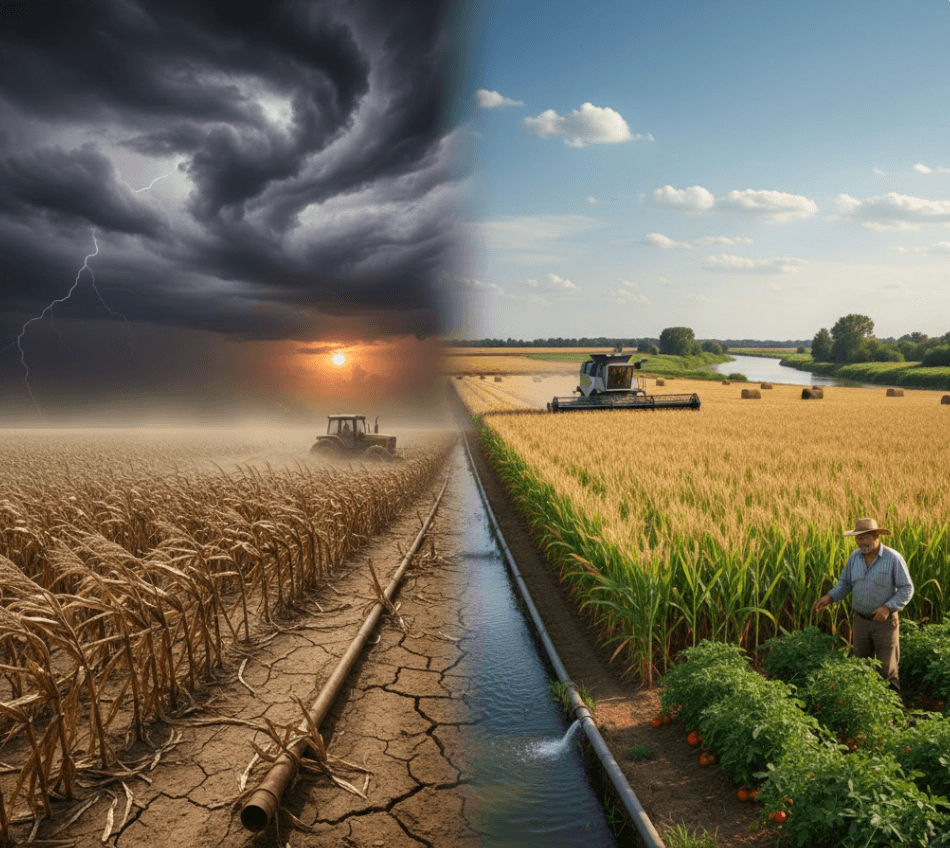
Every year, the seasonal monsoon forecast is published and widely reported. Every year, a large number of farmers make decisions on the basis of a headline that does not mean what it appears to mean.
Understanding what the forecast is actually saying is worth some effort.
"Normal" is a statistical term, not a verdict
When a forecast says normal rainfall, it means the expected total is close to the long-period average for that area, within a defined percentage band.
Two things follow that matter.
It is an average, not a target. The long-period average is calculated over decades. It is a reference point, not a description of ideal conditions for your crop.
It says nothing about distribution. This is the important one.
Distribution beats total, almost always
A season can deliver exactly normal total rainfall and still be agriculturally poor.
Consider two seasons with identical totals. In the first, rain arrives at reasonable intervals across the season. In the second, most of it falls in two extreme events with a long dry spell in between.
Same number. Completely different outcome. The second season floods fields, then leaves the crop in drought during a critical growth stage.
Dry spells during flowering or grain filling cause disproportionate damage regardless of what the seasonal total eventually reads. A forecast headline reporting the total is silent on this.
Scale: national forecasts are not local forecasts
Seasonal forecasts are issued at national and broad regional level. Those areas are vast and internally variable.
An above-normal national monsoon routinely coexists with districts that are substantially deficient. If you make decisions on the national headline, you are using an average across a country to plan a single field.
Sub-divisional and district-level forecasts are more useful. Local observation is more useful still.
Onset is a specific technical thing
Monsoon onset is declared against defined meteorological criteria — sustained rainfall over specified areas, wind patterns, and other indicators.
Two practical consequences:
Pre-monsoon showers are not onset. Rain that arrives ahead of the declared onset can tempt early sowing. If it is followed by a dry gap before the monsoon properly establishes, germinating seed is left exposed and resowing becomes necessary.
Onset at the coast is not onset at your farm. The monsoon advances across the country over weeks. Declared onset over the southern coast means very little for a farm in the north or west for some time yet.
Forecast horizons and what each is for
Seasonal, issued months ahead. Broad risk positioning. Whether to lean toward a shorter-duration variety, how to think about crop mix, whether to prepare contingency plans. Not for date decisions.
Extended range, a few weeks out. Useful for narrowing sowing windows and planning field operations.
Short range, a few days out. This is what you use for actual decisions — sow now or wait, irrigate or hold, spray or postpone.
The mistake is using the wrong horizon for the decision. A seasonal forecast cannot tell you whether to sow this week, and a three-day forecast cannot tell you what variety to buy.
Using it sensibly
Read the sub-divisional forecast, not the headline. Find the figure for your region.
Assume distribution will be uneven. Plan for dry spells within the season regardless of what the total says. Contingency matters more than the seasonal number.
Do not sow on pre-monsoon rain alone. Wait for the monsoon to establish, or accept and plan for resowing risk.
Use short-range forecasts for timing. That is what they are accurate enough for.
Watch updates. Forecasts are revised as the season develops. A March projection is not a June projection.
Keep your own record. Note when rain arrived and how much, each year. Over several seasons your own observations for your own field become more useful than any regional forecast — because they describe exactly the place you farm.
What forecasting cannot do
Seasonal forecasting is genuinely difficult and the skill, while improving, has limits. Forecasts are probabilistic statements, not predictions.
The right use is to shift the odds in your favour — position for the likely case while remaining able to survive the unlikely one. Treating a forecast as a promise is how people get caught out.
Forecast products, terminology and issuing schedules are set by the India Meteorological Department and may be updated. Refer to IMD for authoritative current forecasts.